
Chemical Packaging Types: The Drum, IBC and FIBC Guide Procurement Teams Actually Need
- 1 day ago
- 11 min read
Key Takeaways
Chemical packaging is a compatibility decision first and a cost decision second — the wrong material against the wrong chemical class fails long before the shipment reaches its destination.
A UN packaging code such as 1H1/Y1.4/150/25/IN/1234 packs five separate facts into one string: container type, material, closure design, packing-group approval and test rating. Misreading the X/Y/Z letter is the single most common compliance error in export documentation.
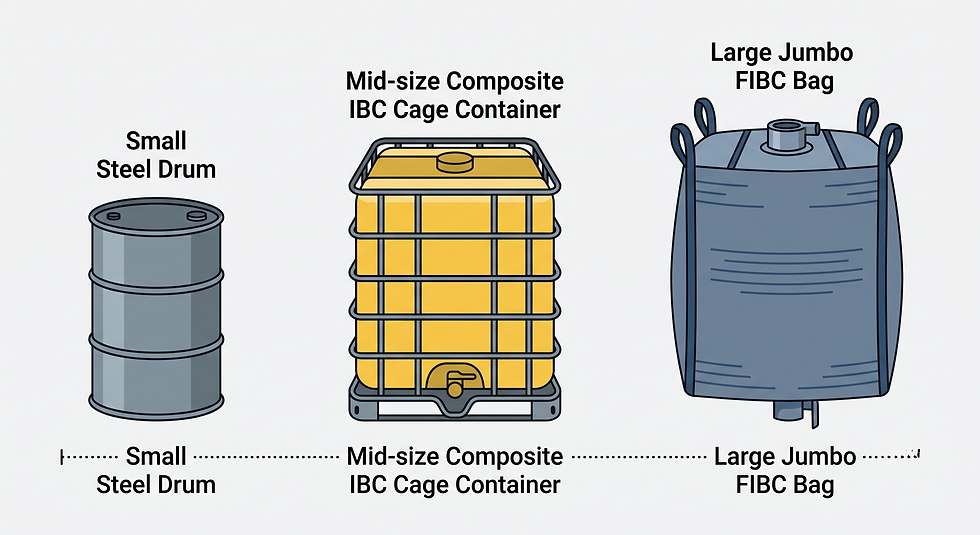
200-210 litre steel or HDPE drums remain the default for parcel-size liquid shipments; composite cage IBCs (1,000 L) generally overtake drums on cost and handling once a shipment crosses roughly five drum-equivalents.
Bulk solids and powders — Sorbic Acid, Sulfamic Acid, and similar dry actives — move in FIBCs (jumbo bags) or multi-wall paper/poly sacks, not drums, once quantities exceed a few hundred kilograms.
India's Plastic Waste Management (Second Amendment) Rules, 2025 require QR-code or barcode traceability on plastic packaging from July 2025, with rising recycled-content obligations from FY 2026-27 — this now reaches HDPE drums and IBC inner bottles, not just consumer packaging.
BIS standards (IS 1783 Part 1, IS 13997) govern domestic manufacture of steel, fibre and open-top drums; UN Model Regulations govern cross-border transport approval. A drum can carry a valid ISI mark and still be non-compliant for export — the two certification regimes test different things.
Reconditioned steel drums and returnable IBCs are now standard practice on EU-bound shipments and increasingly requested by Indian buyers for cost and sustainability reasons.
Introduction
Ask five people in a chemical supply chain “what packaging should I use” and you will get five different answers, because the question is really four questions wearing one sentence: what does the chemical do to the container, what does the container need to prove to a transport regulator, how much are you shipping, and who is going to lift it at the other end. Get any one of those wrong and you have a corroded drum, a rejected export consignment, or a warehouse worker manually rolling something that should have moved on a pallet jack.
This guide works through chemical packaging the way a procurement or QA team actually needs it: by format (drums, IBCs, FIBCs, carboys, sacks, tank containers), by material compatibility (what attacks steel, what permeates HDPE, what needs glass), by the UN and BIS certification systems that govern what you're legally allowed to ship, and by the decision math between drums and IBCs that most vendor literature glosses over. It also covers where Indian regulation has moved in 2025-2026 — specifically the plastic-packaging traceability and recycled-content rules that now apply directly to the drums and IBC bottles chemical companies buy every month. If you handle procurement, quality assurance, or regulatory documentation for chemical shipments — inbound or outbound — this is the reference to keep open.
What Chemical Packaging Actually Has to Solve
Packaging for chemicals is not “a container that holds liquid.” It is doing four jobs simultaneously, and a packaging spec that only solves one or two of them will eventually fail:
Containment — the packaging material must resist the chemical it holds for the full shelf life and transit time, without corroding, swelling, permeating, or reacting with it.
Hazard communication — GHS labelling, UN diamond markings, and (for domestic Indian shipments) BIS-compliant markings need to be legible and durable on the container itself, not just on a paper insert.
Regulatory transport compliance — for anything classified as dangerous goods, the packaging itself must carry a valid UN performance certification matched to the substance's packing group, on top of whatever domestic manufacturing standard it was built to.
Handling economics — cost per litre, manual-handling risk, warehouse footprint, and reverse logistics (can the container be reconditioned or must it be scrapped) all compound over hundreds of shipments even when they look trivial on a single invoice.
A packaging decision that is correct for a 200 kg export parcel of a specialty grade moving to a cosmetic formulator in the EU is often wrong for the same chemical moving 20 MT domestically to an industrial customer three states away — different packing group exposure, different handling infrastructure at the receiving dock, different reconditioning economics.
Decoding the UN Packaging Code
Every UN-certified container carries a marking that looks like a string of noise until you know the grammar. Take a typical steel drum marking:
1A1/Y1.4/150/25/IN/MUM-0456
Read left to right, this single string answers five separate compliance questions:
Code segment | What it tells you |
1 | Packaging type — 1 = drum, 3 = jerrican, 5 = bag, 6 = composite packaging, 11 (or similar) = IBC |
A | Construction material — A = steel, B = aluminium, C = natural wood, D = plywood, G = fibreboard, H = plastic, N = other metal, P = glass/porcelain/stoneware |
1 (second digit) | Design variant — 1 = tight-head/non-removable head (for liquids), 2 = open-head/removable head (often for solids or viscous pastes) |
Y | Packing group approval — X (PG I, II, III — highest rating), Y (PG II, III only), Z (PG III only, lowest rating) |
1.4 | For liquids: maximum permitted specific gravity of the contents at the tested packing group. For solids: maximum gross mass in kilograms |
150 | Hydrostatic test pressure in kPa the container has passed (liquids only) |
25 | Year of manufacture |
IN | Country code of the approving authority |
MUM-0456 | Manufacturer/approval body identification code |
The X / Y / Z rating is where most compliance failures happen
Packing groups run from I (highest danger) to III (lowest danger), and the letter on the drum tells you which groups it is approved to carry — not which group your chemical happens to be. An X-rated container can carry PG I, II or III material; a Y-rated container can carry PG II or III but never PG I; a Z-rated container is restricted to PG III only. Over-qualifying (using an X-rated drum for a PG III chemical) is legal and simply costs more. Under-qualifying — using a cheaper Z-rated drum for a chemical that is actually PG II — is a straightforward violation, and it is also the easiest one for an inspector to catch, because the mismatch is printed right there on the drum.
Practical note for procurement teams: never accept a vendor's assurance that a drum is “suitable for hazardous chemicals” as sufficient. Ask for the specific UN code and cross-check the X/Y/Z letter against the packing group assigned to your substance in its SDS (Section 14, Transport Information) before the first shipment goes out.
The Packaging Formats Used Across the Chemical Supply Chain
Most chemical shipments — solid or liquid, hazardous or not — end up in one of seven formats. Choosing between them is mostly a function of volume and physical state, with hazard classification and light/moisture sensitivity as the usual override conditions.
Format | Typical volume | Physical state | Common UN code family | Best suited for | Generally avoid for |
Steel drum (tight-head) | 200–210 L | Liquids | 1A1 | Solvents, oils, many organics; robust against physical damage | Strong mineral acids without internal lining |
Steel drum (open-head) | 200–210 L | Solids, pastes, viscous liquids | 1A2 | Resins, sludges, viscous or crystallising products | Free-flowing liquids needing a sealed tight-head |
HDPE/plastic drum (tight-head) | 60 / 120 / 210 L | Liquids, especially acids | 1H1 | Sulphuric, hydrochloric, nitric acid; most aqueous corrosives | Strong organic solvents that swell or permeate HDPE |
Fibre drum | Varies, typically 25–100 kg | Solid powders, granules | 1G | Powders, flakes, moisture-sensitive solids with a poly liner | Any liquid — fibre drums are not leakproof |
Jerrican / carboy (HDPE) | 5–50 L | Liquids | 3H1 / 3H2 | Lab reagents, sample shipments, small-pack retail chemical sales | Bulk industrial volumes — cost per litre rises fast |
Composite IBC (cage + HDPE bottle) | 1,000 L | Liquids | 31HA1 / 31HZ1 | Mid-to-large liquid shipments once volume exceeds ~5 drums | UV-sensitive product — bottle is translucent |
FIBC / jumbo bag | 500 kg–2 MT | Powders, granules, flakes | 13H / 13M / 13L | Bulk dry actives, technical-grade solids for industrial buyers | Liquids, or products needing airtight/moisture-proof seal without a liner |
Multi-wall paper/poly sack | 25–50 kg | Powders | 5H / 5M | Domestic retail-size industrial chemical sales | Export shipments needing UN liquid-grade certification |
ISO tank container / tank truck | 16–25 MT+ | Bulk liquids | T-code (T1–T22) | High-volume repeat liquid shipments, single buyer, single grade | Multi-grade or infrequent shipments — dedicated cleaning cost is high |
Material Compatibility: Where Packaging Actually Fails
Almost every packaging failure our QA teams investigate traces back to one of two root causes: the chemical was put in a container the material simply cannot resist, or the closure/gasket material was overlooked even though the drum body was correctly specified. The drum body and the gasket are not the same compatibility decision — a HDPE drum with an EPDM gasket can still fail if the product attacks EPDM specifically.
Chemical class | Generally compatible | Generally incompatible | Why it fails |
Strong mineral acids (H₂SO₄, HCl, HNO₃) | HDPE, PP, PTFE-lined steel | Bare mild steel, most non-stainless metals | Direct corrosive attack on the metal; HDPE resists but check concentration and temperature limits |
Alkalis / caustic solutions | HDPE, PP | Aluminium and its alloys | Aluminium reacts with strong alkalis, generating hydrogen gas and pressure build-up |
Aromatic / chlorinated solvents | Steel (lined or unlined, per grade) | Untested HDPE grades | Some HDPE grades swell, soften or permeate over time with certain organic solvents |
Oxidizers (peroxides, persulfates) | Vented HDPE or steel closures, per manufacturer rating | Combustible packaging materials, tight unvented seals | Off-gassing without a vent builds pressure; incompatible organics can trigger decomposition |
Hygroscopic / moisture-sensitive powders | Poly-lined fibre drums, multi-wall poly sacks | Unlined fibreboard, unlined paper | Moisture ingress causes caking, hydrolysis, or loss of active content |
Light/UV-sensitive actives | Opaque HDPE, amber glass | Translucent HDPE IBC bottles | UV exposure through translucent walls degrades photosensitive actives over transit and storage time |
This is also why reusing a drum across chemical families is a genuine QA risk, not just a housekeeping preference. A drum that previously held an oxidizer and is reused for an organic solvent without full residue verification is a reaction risk, not a cost saving.
The Regulatory Landscape Governing Chemical Packaging in India
Three separate regulatory regimes apply to chemical packaging in India, and they answer different questions. Confusing them is the second most common compliance gap we see after the UN code misreading covered above.
BIS standards — domestic manufacturing quality
IS 1783 (Part 1) covers large fixed-end steel and fibre drums manufactured for the domestic market and carries the ISI mark requirement; IS 13997:2014 separately covers large open-top drums used across chemical, petroleum and manufacturing sectors. These standards certify that a drum was built to a consistent domestic quality benchmark. They do not, by themselves, certify the drum for international dangerous-goods transport — that is a separate UN testing and approval process, and a drum can legitimately hold a valid ISI mark while lacking any UN performance certification at all.
MSIHC Rules, 1989 (as amended) — storage and handling of hazardous chemicals
The Manufacture, Storage and Import of Hazardous Chemical Rules remain the operative law governing on-site storage, handling and import of hazardous chemicals in India, built around three schedules of listed and criteria-based hazardous substances. A long-anticipated replacement — the Chemicals (Management and Safety) Rules, informally called “India REACH” — has been under draft since 2020 and is not yet in force, so MSIHC obligations continue to apply to packaging, labelling and storage decisions for scheduled hazardous chemicals.
Plastic Waste Management (Second Amendment) Rules, 2025 — where 2025-2026 changed the picture
This is the update procurement and packaging teams are most likely to have missed, because it was framed publicly around consumer plastic waste rather than industrial packaging. Effective 1 July 2025, producers, importers and brand owners are required to carry on-pack traceability information — a QR code, barcode, or unique identifier linking back to a CPCB registration number — under Rule 11 of the amended rules. Rigid plastic packaging separately carries rising recycled-content obligations, with a 40% recycled-content target specified for FY 2026-27. Neither obligation is worded to exclude industrial packaging, and HDPE drums and IBC inner bottles are, mechanically, rigid plastic packaging — so companies sourcing or manufacturing these containers should confirm their vendor's compliance status rather than assume the rule only touches FMCG-style packaging.
Cross-border transport — UN Model Regulations, ADR, IMDG
For anything moving across a border, the UN Recommendations on the Transport of Dangerous Goods (and their regional implementations — ADR for European road transport, IMDG for sea freight) govern the packaging certification requirement described in Section 2. A shipment can be fully MSIHC-compliant for domestic storage and still be rejected at a port of loading if the packaging's UN certification doesn't match the declared packing group.
Drum vs IBC: The Actual Decision, Not the Sales Pitch
Vendor literature on both sides tends to oversimplify this choice. The honest version is a threshold problem: below a certain volume, drums win on flexibility and unit cost; above it, IBCs win on total handling cost even though the per-unit price is higher.
Unit economics cross over around 5 drum-equivalents. A single 1,000 L composite IBC replaces roughly five 200 L drums; once a shipment consistently reaches that volume, the IBC's lower cost per litre in freight, warehouse footprint and handling labour typically overtakes the higher upfront unit price.
Handling risk drops with IBCs. A single mechanical lift of one IBC replaces the repeated rolling, tilting and manual positioning that five drums require — a meaningful factor where manual handling injuries or product spillage from dropped drums are a recorded risk.
Drums still win for small parcels, UV-sensitive product (opaque HDPE vs a translucent IBC bottle), and any single-use or contamination-sensitive cargo where a returnable IBC's cleaning-between-uses assumption doesn't hold.
IBCs require periodic recertification — typically on a testing cycle of roughly two and a half years under UN rules — which needs to be tracked as an asset-management task if you own rather than rent your IBC fleet.
Reconditioning and the Circular Packaging Shift
Steel drum reconditioning — inspection, cleaning, re-testing and requalification of used drums for continued dangerous-goods service — is a mature industry in Europe and increasingly expected by EU-bound buyers on both cost and sustainability grounds. Returnable IBC programmes, where the container is collected, cleaned and requalified for reuse rather than scrapped after one trip, follow the same logic at larger volume. India's packaging regulation is moving in the same direction: the recycled-content targets under the 2025 Plastic Waste Management amendment apply direct commercial pressure on rigid HDPE packaging manufacturers to build reconditioning and recycled-resin capability rather than treat drums and IBC bottles as single-use.
Common Compliance Mistakes Procurement and QA Teams Actually Make
Buying Z-rated packaging for a chemical that is actually classified Packing Group II, on the assumption that any UN mark is “good enough.”
Treating a valid BIS/ISI mark as equivalent to UN transport certification — they test different things, and export shipments need the latter regardless of domestic compliance status.
Reusing a drum across different chemical families without residue verification, creating both a corrosion risk (from the new product attacking whatever coating the old product left behind) and a reaction risk.
Specifying the drum body material correctly but overlooking the gasket/closure material, which can fail against the product even when the drum itself would not.
Ignoring vent requirements for chemicals that off-gas, ferment, or generate pressure over the shelf life of the shipment — a sealed tight-head container is the wrong choice regardless of how compatible the base material is.
Frequently Asked Questions
Can I use an X-rated drum for a Packing Group III chemical?
Yes. X-rated packaging is approved for PG I, II and III, so it is always acceptable for a lower-hazard PG III substance — the only trade-off is cost, since X-rated containers are built and tested to a higher standard than strictly necessary for that shipment.
Is BIS certification the same as UN certification?
No. BIS standards (IS 1783, IS 13997) certify domestic manufacturing quality and carry the ISI mark; UN certification is a separate performance-testing regime required for dangerous-goods transport, especially across borders. A drum can hold one without the other.
What is the real difference between tight-head and open-head drums?
A tight-head drum has a fixed top with small bung openings and is built for free-flowing liquids that need a sealed, spill-resistant closure. An open-head drum has a fully removable lid secured by a bolt ring, designed for solids, pastes, viscous products, or any content that needs to be scooped or poured rather than pumped.
Do IBCs need retesting once they are in service?
Yes. UN-certified IBCs carry a periodic retest and recertification requirement — commonly on a roughly two-and-a-half-year cycle — which needs to be tracked as part of asset management for any company operating its own returnable IBC fleet rather than renting on a per-shipment basis.
Does the 2025 Plastic Waste Management amendment really apply to industrial chemical packaging?
The rule is not worded to exclude it. Rigid plastic packaging — which includes HDPE drums and IBC inner bottles — falls within the traceability and recycled-content obligations introduced from July 2025 onward, so packaging procurement teams should confirm their supplier's registration and compliance status rather than assume the rule is limited to consumer-facing packaging.
Conclusion
Chemical packaging selection collapses into four practical checks once you strip away the marketing language: does the material resist the chemical for the full shelf life and transit time, does the container's UN packing-group rating match (or exceed) what the substance actually requires, does the format make sense at your shipment volume, and does the packaging comply with both the domestic manufacturing standard (BIS) and the applicable transport regime (UN/ADR/IMDG) plus the 2025 plastic-packaging traceability rules where relevant. Get those four right and the packaging becomes invisible — which is exactly what it should be. Get any one wrong, and it becomes the most expensive line item on the shipment, whether that cost shows up as a corroded drum, a rejected export consignment, or a compliance penalty that dwarfs whatever was saved on the container in the first place.


informative