
Chemical Grades Explained: A Procurement and Formulation Guide to ACS, USP, Technical, and Reagent Purity Standards

Key Takeaways
Chemical grade is not a marketing label — it is a documented purity and testing standard (ACS, USP-NF, BP, EP, FCC, HPLC, technical) that determines whether a material is legally and functionally fit for a specific end use.
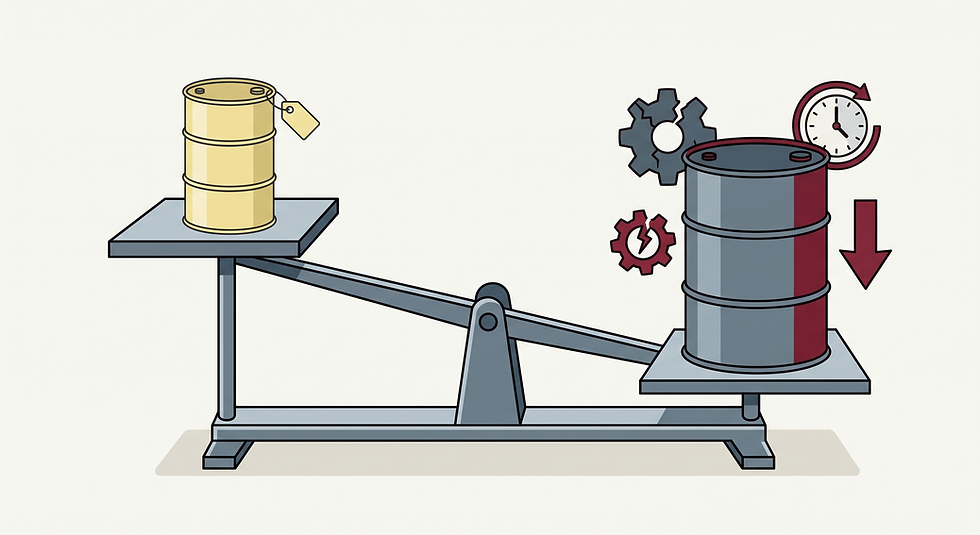
Over-specifying purity (buying ACS-grade solvent for tank cleaning) and under-specifying it (using technical-grade acid in a food process) are both procurement failures — one wastes budget, the other creates recall and compliance risk.
USP/NF, BP, and EP/Ph. Eur. grades are compendial standards tied to specific regulatory jurisdictions (US, UK/Commonwealth, EU). A material passing USP does not automatically clear an EU dossier, and vice versa — this is a common sourcing trap for companies selling across borders.
ACS grade and Reagent grade are frequently treated as interchangeable, but ACS grade is tied to a published monograph with defined impurity ceilings, while "Reagent grade" without an ACS monograph reference is a supplier-defined term — always request the Certificate of Analysis (CoA), not just the label.
Instrument-specific grades (HPLC, GC, LC-MS, spectroscopic) are qualified against the analytical method, not against a general purity percentage — a chemical can be 99.9% pure and still fail LC-MS grade because of trace metal adducts.
Grade selection has become a supply chain resilience question, not just a quality question — pharmaceutical and specialty chemical buyers are now qualifying multiple grade-equivalent suppliers across geographies in response to tightening API and excipient supply chains.
Documentation — CoA, batch traceability, pharmacopeial cross-reference, and REACH/TSCA compliance data — is now weighted as heavily as price in supplier scorecards for regulated industries.
Introduction
A procurement manager sourcing sodium hydroxide for three different plants — one making soap, one running a wastewater treatment unit, and one manufacturing an oral pharmaceutical excipient — cannot use the same purchase order. The molecule is identical. The grade is not. Chemical grade is the specification layer that sits on top of a molecule's identity and determines whether it can legally and functionally enter a given process.
This guide exists because "just get me the chemical" is where most costly sourcing mistakes begin. Buyers who don't distinguish between ACS, USP, technical, and food grade either overpay for purity their process doesn't need, or underbuy purity their compliance framework demands. Both mistakes are expensive — one shows up as margin erosion, the other shows up as a failed batch, a regulatory audit finding, or a product recall.
What follows is a working reference for procurement heads, QA teams, formulators, and R&D scientists who need to match chemical grade to application with defensible, auditable logic — not guesswork. It covers the major grading systems in use globally, how they differ by region and regulator, what they actually cost in practice, where buyers get tripped up, and how sourcing strategy for graded chemicals is shifting in 2026 as supply chains diversify away from single-country dependency.
What Is a Chemical Grade, Exactly?
A chemical grade is a purity and quality classification that specifies:
Minimum assay (purity percentage) of the target compound
Maximum permitted levels of specific impurities (heavy metals, residual solvents, moisture, particulates, microbial load where relevant)
The testing method used to verify the above
The intended application the grade is qualified for
Grade is not a single sliding scale from "dirty" to "pure." It is closer to a set of parallel certification tracks, each built around a different end use — analytical laboratories, pharmaceutical manufacturing, food production, electronics fabrication, or general industrial processing. A chemical can be extremely pure and still be the wrong grade for a job, because the type of impurity control matters as much as the amount.
For example, HPLC-grade acetonitrile is filtered and tested for UV absorbance and low particulate content because the concern is chromatographic baseline noise — not heavy metals. USP-grade excipients, by contrast, are tested heavily for heavy metals, residual solvents, and microbial limits because the concern is patient safety. Both can carry a purity figure above 99.5%, and neither can substitute for the other without requalification.
The Chemical Grade Hierarchy: A Practical Reference Table
Grade | Typical Purity | Governing Standard | Primary Use Case | Relative Cost Index |
Technical / Industrial Grade | ~80–95% | Manufacturer-defined, no compendial monograph | Bulk manufacturing, cleaning, water treatment, textile/plastic/paper processing | 1x (baseline) |
Laboratory (Lab) Grade | Variable, undocumented impurity profile | No formal standard | Education, demonstrations, non-critical general lab use | 1.2–1.5x |
ACS Reagent Grade | ≥95%, often much higher for specific analytes | American Chemical Society monographs (Reagent Chemicals) | Analytical testing, QC labs, research requiring documented impurity ceilings | 2–4x |
Reagent Grade (non-ACS) | Comparable to ACS but supplier-defined | Varies by manufacturer; often modeled on ACS | General lab/analytical use where a formal ACS monograph doesn't exist for that compound | 2–3.5x |
USP / NF Grade | Meets USP–NF compendial monograph | United States Pharmacopeia / National Formulary | Pharmaceutical manufacturing, dietary supplements, some food additives | 2.5–5x |
BP / Ph. Eur. (EP) Grade | Meets regional pharmacopeial monograph | British Pharmacopoeia / European Pharmacopoeia | Pharmaceutical manufacturing for UK/Commonwealth and EU markets respectively | 2.5–5x |
FCC (Food Chemicals Codex) Grade | Meets FCC monograph (now maintained under USP) | Food Chemicals Codex | Direct and indirect food additives | 2–3.5x |
HPLC / GC / LC-MS Grade | >99.9%, method-specific | Supplier-qualified against instrument method | Chromatography, mass spectrometry, trace analysis | 4–8x |
Electronic / Semiconductor Grade | 99.999%+ ("5N" and above) | SEMI standards, internal fab specs | Wafer fabrication, photoresist processing, cleanroom chemistry | 10x+ |
Analytical Reagent (AR) Grade | ≥95%, impurities specified | Regional pharmacopeial/analytical bodies (common outside the US) | Titration, spectrophotometry, quantitative analytical work | 2–4x |
Price multiples are directional and vary by molecule, supplier, and order volume — always benchmark against your own historical spend rather than treating this table as a quote.
Where Buyers Actually Get This Wrong
Scenario 1 — Over-specification
A mid-size contract manufacturer producing industrial degreasers was purchasing ACS-grade isopropyl alcohol for a shop-floor cleaning application that had no analytical or regulatory requirement for that purity level. Switching to technical-grade IPA for that specific line — while retaining ACS grade for the QC lab — cut raw material spend on that SKU by roughly 40% with zero impact on product performance. This is one of the most common line items a procurement audit uncovers, because grade selection often gets "inherited" from an early formulation decision and never revisited as volumes scale.
Scenario 2 — Under-specification
A nutraceutical formulator sourced magnesium stearate at technical grade to save on unit cost, assuming the compound was "basically the same" across grades. The material failed heavy metal limits during a customer audit, halting shipment of a finished batch and triggering a supplier requalification. The cost of the schedule slip and requalification far exceeded the entire year's savings from the cheaper grade.
Scenario 3 — Regional mismatch
A company manufacturing for both the US and EU markets used USP-grade excipients across both product lines, assuming USP compliance would satisfy EU regulators. Ph. Eur. monographs sometimes carry different impurity limits or test methods for the same nominal compound. The EU-bound batches required separate sourcing against Ph. Eur. specifications, adding a second qualified supplier relationship the company hadn't budgeted for.
The pattern across all three: grade is treated as a checkbox rather than a specification that needs to be re-verified against the actual downstream use, market, and regulatory jurisdiction every time a formulation, customer base, or plant changes.
Grade Selection From Different Vantage Points
Procurement's Perspective
Grade is a cost lever. The instinct is to negotiate down to the cheapest grade that clears QA. This is correct discipline — but it only works if procurement has visibility into why a grade was originally specified. Grade decisions made by R&D three product generations ago often outlive their justification. A periodic "grade rationalization" review, done jointly with QA, is one of the highest-ROI activities a procurement team can run on a mature product line.
QA's Perspective
Grade is a compliance boundary, not a preference. QA teams care about the CoA matching the pharmacopeial or ACS monograph, batch-to-batch consistency, and whether the supplier's test methods are validated and traceable. A grade label on a drum means nothing without a CoA that ties back to a recognized standard — QA teams that accept grade claims without CoA verification are carrying undisclosed risk.
R&D and Formulators' Perspective
Grade affects reproducibility. A formulator validating a process with reagent-grade material and then scaling to technical-grade for production can introduce trace impurities that were never present during method development — changing reaction kinetics, color, odor, or shelf stability in ways that are hard to trace back to a "grade downgrade" that looked cost-neutral on paper. Locking the production-grade specification during the R&D phase, not after scale-up, avoids this.
Manufacturing/operations' Perspective
Grade affects equipment. Higher-purity materials sometimes behave differently in bulk handling (viscosity, hygroscopicity, particle size) than their technical-grade counterparts, which can affect dosing equipment calibration when a grade change is made without a parallel process validation.
Regional and Regulatory Grade Systems: Why "Pharma Grade" Isn't One Thing
Pharmaceutical-grade sourcing is where grade confusion causes the most expensive mistakes, because "pharmaceutical grade" is often used as an informal catch-all when it actually spans several distinct, non-identical compendial systems:
USP–NF (United States): Governs drug substances, excipients, dosage forms, and dietary supplements sold into the US market. All drug products in the US must comply with current USP-NF standards.
Ph. Eur. / EP (European Union): The European Pharmacopoeia sets the compendial standard for the EU. Materials must meet Ph. Eur. monographs to be used in EU-registered pharmaceutical products, even if the same compound already carries USP certification.
BP (United Kingdom): The British Pharmacopoeia, used for the UK and various Commonwealth-influenced markets, historically aligned with — but not identical to — Ph. Eur. specifications.
IP (India): The Indian Pharmacopoeia governs materials manufactured for or sold into the Indian pharmaceutical market, which has become one of the largest global sources of APIs and excipients.
JP (Japan): The Japanese Pharmacopoeia applies for the Japanese market and carries its own monograph specifications.
For a buyer supplying multiple regulatory markets, the practical implication is this: a single "pharma-grade" SKU from one supplier rarely clears every jurisdiction automatically. Multinational manufacturers frequently maintain dual or triple pharmacopeial CoAs (USP/EP/BP) for high-volume excipients precisely so the same physical batch can be documented against whichever market it ships to, avoiding duplicate inventory.
APIs (Active Pharmaceutical Ingredients) and excipients also carry different regulatory weight even within the same pharma-grade category. APIs fall under ICH Q7 GMP guidance as drug substances requiring dedicated pharmaceutical GMP certification, while excipients are governed by ICH Q8 and IPEC-PQG GMP guidelines — stricter than food-grade requirements but with lighter audit obligations than full API GMP. Procurement teams sourcing both need to qualify suppliers against two different documentation burdens, not one.
Grade by Application: A Cross-Industry View
Pharmaceutical manufacturing
USP/NF, Ph. Eur., BP, or IP grade depending on target market; strict heavy metal, residual solvent, and microbial limits; full batch traceability and GMP-certified origin required.
Food and beverage
FCC (Food Chemicals Codex) grade for direct additives; food-grade designation may also apply to indirect-contact chemicals like cleaning agents used in food processing environments, which carry different testing criteria than additive-grade materials of the same name.
Analytical and QC laboratories
ACS reagent grade or equivalent, chosen specifically because the impurity ceiling is documented and traceable — critical for defensible test results in regulated industries.
Electronics and semiconductor manufacturing
Ultra-high-purity grades (often expressed in "N" notation — 5N, 6N, meaning 99.999% or 99.9999% purity), governed by SEMI standards, where trace metallic contamination at parts-per-billion levels can affect wafer yield.
Water treatment
A mix of technical-grade bulk chemicals (for coagulation, pH adjustment) and higher-purity grades for potable water applications where NSF/ANSI 60 certification, not ACS or USP, is often the relevant standard in the US.
Cosmetics and personal care
Frequently uses USP, NF, or FCC-grade raw materials even though cosmetics aren't drugs, because these compendial grades offer a documented, internationally recognized purity baseline that supports ingredient safety claims.
Agrochemicals
Technical-grade active ingredients (a specific, defined term in this industry meaning the concentrated, largely unformulated active substance before it's blended into a commercial formulation) — not to be confused with "technical grade" as used in general industrial chemical procurement.
Emerging Trends and Market Developments (2026)
Grade selection is becoming a supply-chain-resilience decision, not just a quality decision
With API and excipient supply concentrated heavily in China and India, pharmaceutical and specialty chemical buyers are increasingly qualifying two or three grade-equivalent suppliers across different geographies for their highest-volume materials, rather than optimizing for a single lowest-cost source. This shift is echoed in fine and specialty chemical capacity expansion happening across the US, with contract manufacturers investing in flexible multi-purpose reactor capacity to serve pharmaceutical intermediates, electronic chemicals, and agrochemical intermediates domestically.
Regulatory frameworks are starting to reward supply security, not just price
The EU's proposed Critical Medicines Act, moving through the European Parliament and Council with a vote anticipated around late 2026 or early 2027, aims to shift pharmaceutical procurement away from single-winner, lowest-price tenders toward criteria that account for quality, security of supply, and environmental compliance — a direct response to medicine shortages exposed during 2020–2022 that were traced back to concentrated API and excipient sourcing.
China's regulatory environment for hazardous and graded chemicals is tightening
A new Law on the Safety of Hazardous Chemicals took full effect in China in May 2026, introducing stricter full-lifecycle regulatory oversight for chemical manufacturers — a relevant development for buyers sourcing graded chemicals from Chinese suppliers, since compliance documentation requirements on the supplier side are becoming more rigorous.
Digital procurement platforms are becoming grade-aware, not just price-aware
Chemical-specific sourcing platforms are increasingly building in automated compliance verification — cross-referencing supplier CoAs against pharmacopeial monographs, REACH, TSCA, and GHS requirements — rather than treating chemical purchasing like generic indirect procurement. This matters directly for grade selection because it reduces the manual burden of verifying that a quoted "USP grade" material actually carries a valid, current CoA against the monograph.
Domestic and nearshored capacity for pharmaceutical intermediates and KSMs (Key Starting Materials) is expanding
partly driven by national security concerns around pharmaceutical supply concentration. This is gradually giving buyers more optionality on where they qualify pharma-grade and technical-grade suppliers, though price parity with established Asian supply chains is not yet consistent across all molecule categories.
A Practical Grade Selection Framework for Procurement Teams
When qualifying or re-qualifying a chemical purchase, work through these questions in order:
What regulatory framework governs the finished product? (Drug product under FDA/EMA, food product under FDA/FSSAI/EFSA, cosmetic, industrial process with no direct regulatory chemical grade requirement.)
Which pharmacopeial or standards body applies to your target market(s)? USP for the US, Ph. Eur. for the EU, BP for the UK, IP for India — source and document against the correct one, or maintain dual documentation if you ship cross-border.
Does your analytical method require a specific instrument-qualified grade? (HPLC, GC, LC-MS grade — check against the method's validation data, not just a general purity percentage.)
What did your original process validation or method development use? Any grade downgrade from what was used during validation needs to go through a documented change-control and, where relevant, revalidation process — not a silent substitution.
What does the CoA actually say? Request and retain the Certificate of Analysis for every lot, not just the first qualifying batch. Confirm test methods referenced on the CoA match the compendial or ACS monograph being claimed.
Is there a lower grade that meets the actual functional and regulatory requirement? This is the procurement cost-optimization question, and it should only be asked after questions 1–5 are answered — never before.
Do you have a second qualified source at the same grade? Especially for pharma-grade and high-purity analytical materials, single-sourcing a specific grade is an increasingly recognized supply chain risk, not just a cost inefficiency.
Frequently Asked Questions
Is ACS grade the same as reagent grade?
Often functionally equivalent, but not guaranteed identical. ACS grade means the chemical is tested against a published American Chemical Society monograph with defined impurity ceilings. "Reagent grade" without an ACS reference is a broader, supplier-defined term that may or may not match the ACS specification exactly. Always check the CoA rather than assuming equivalence from the label alone.
Can USP-grade chemicals be used for non-pharmaceutical applications?
Yes — USP grade is often used in food, cosmetics, and dietary supplement applications because it provides a well-documented purity baseline, even where USP compliance isn't strictly mandated by the regulator for that specific use.
Why is technical-grade chemical cheaper than lab or ACS grade for the exact same molecule?
Technical grade doesn't carry the cost of monograph-level impurity testing, documentation, and traceability that ACS, USP, or pharmacopeial grades require. The molecule may be chemically similar, but the testing, documentation, and consistency guarantees behind it are not — and that's what the price difference reflects.
Does a higher purity percentage always mean a "higher" grade?
No. Grade is about matching impurity control and documentation to a specific application, not a simple purity ranking. An HPLC-grade solvent and a USP-grade excipient can both carry very high purity figures while being tested for entirely different impurity profiles relevant to their respective uses.
How often should a company re-verify its chemical grade specifications?
At minimum, whenever a product's regulatory market changes, a formulation is modified, a new supplier is qualified, or on a periodic (typically annual) audit cycle for high-volume or regulated materials. Grade specifications that were correct at product launch can become outdated as markets, regulations, and formulations evolve.
What happens if a supplier's CoA doesn't match the claimed grade?
This should trigger a formal deviation and supplier corrective action process. Using material with an unverified or non-conforming CoA in a regulated product is one of the more common root causes cited in FDA Form 483 observations and product recalls tied to raw material quality.
Conclusion
Chemical grade selection sits at the intersection of cost control, regulatory compliance, and process reliability — and treating it as a single decision made once during product development is where most of the expensive mistakes originate. The distinctions between technical, reagent, ACS, USP, Ph. Eur., BP, FCC, and instrument-specific grades aren't academic; they reflect genuinely different testing regimes built for different risks.
The buyers who get the most value out of their raw material spend are the ones who revisit grade specifications periodically, verify every claim against an actual CoA rather than a label, understand which pharmacopeial system governs each market they sell into, and treat supplier diversification for critical grades as a resilience strategy rather than a cost center. As global sourcing patterns shift — with pharmaceutical and specialty chemical supply chains actively diversifying away from single-country concentration — grade literacy has become as much a procurement competency as price negotiation.

good read