
Why the Cheapest Chemical Supplier Almost Always Costs You More
- Aug 11
- 10 min read
Key Takeaways
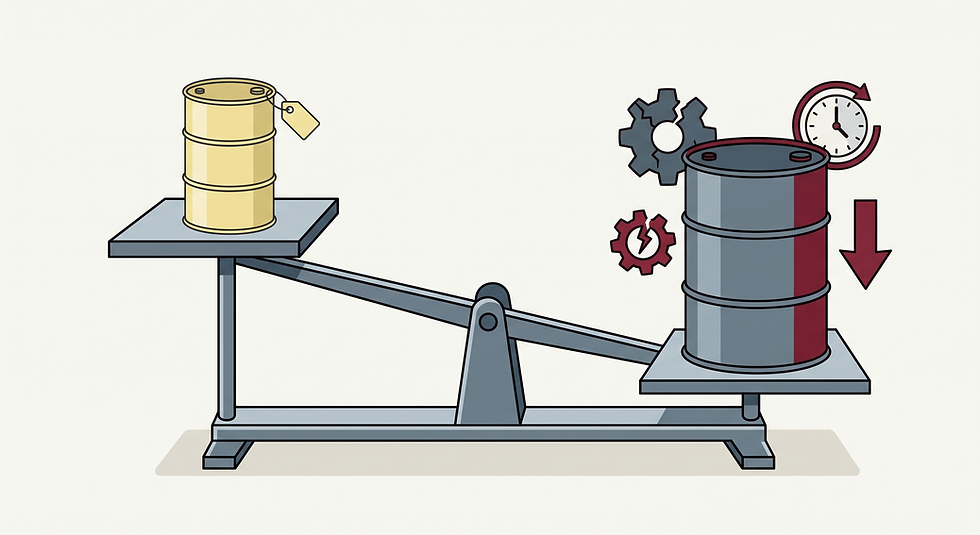
Landed price is one line item; Total Cost of Ownership (TCO) is the real number, and supplier-driven disruptions can push TCO up by as much as 40% per incident on top of the quoted price.
The Cost of Poor Quality (COPQ) framework splits into Prevention, Appraisal, and Failure costs — and failure costs, especially external ones that reach a customer or regulator, run 4–5 times higher than the visible scrap or rework number.
A raw-material defect that reaches the finished product is measurably common: one analysis of FDA cosmetic recalls (2011–2023) found 76.8% traced to microbial contamination and 10.2% to inorganic contaminants — both categories procurement can catch before the batch is made, not after.
FDA Warning Letters rose 54.6% in 2025 (708 vs. 458 in 2024), and FDA food recalls hit a nine-year high at 517 in 2025 — regulatory scrutiny of supply-chain quality is tightening, not loosening, across every major market.
In India, BIS Quality Control Orders on industrial chemicals have moved in both directions through 2025-2026 — new QCOs added for chemical intermediates, seven QCOs on other chemicals withdrawn in November 2025 — and suppliers who haven't invested in certification infrastructure are the ones caught flat-footed when a QCO deadline lands.
60% of organizations report at least a 10% year-on-year rise in issues traced to supplier quality defects — this is a trend line, not a one-off.
The fix is not “never buy from the lowest bidder” — it's pricing the risk correctly before the order is placed, through vendor qualification, incoming QC, and tracking COPQ as a procurement KPI rather than a quality-department afterthought.
Introduction
Every procurement negotiation eventually comes down to a number on a quotation, and the lowest number wins more often than it should. The reasoning feels sound in the moment: the specification sheet matches, the certificate of analysis looks clean, and the savings versus the incumbent supplier are real money on this quarter's cost report. What doesn't show up on that quotation is what happens the first time the batch is inconsistent, the shipment is three weeks late during a production run, or a contaminant that should have been caught at goods-inward testing shows up in a finished product recall six months later.
This is not a hypothetical risk procurement teams are told to worry about in the abstract. It is a measurable, recurring pattern across regulated manufacturing sectors — chemicals, pharmaceuticals, food, cosmetics — and the financial mechanics behind it have names: Cost of Poor Quality (COPQ), Total Cost of Ownership (TCO), and external failure cost. This guide works through exactly how a cheap supplier becomes an expensive one, with the cost categories, the current regulatory data behind them, and a practical framework for pricing supplier risk before it becomes a batch failure, a stopped production line, a recall, or a shipment that never arrives on time.
The Real Math: Landed Price vs. Total Cost of Ownership
Landed price — the quoted rate plus freight, duty, and clearing charges — is what shows up on a purchase order. Total Cost of Ownership is what a purchase actually costs once every downstream consequence is added back in: incoming inspection labor, rework or scrap when material fails spec, production downtime while a line waits for conforming material, expedited freight to cover a delay, and — in the worst case — the cost of a recall if a defect gets past every internal check. Industry research on supplier-driven disruption puts the gap in concrete terms: supplier risk events can increase Total Cost of Ownership by up to 40% per incident, and organizations report an average of roughly 17 unfamiliar, high-impact supply disruptions a year that a purely price-based sourcing model never sees coming.
The PAF model: where quality cost actually lives
The standard framework for this is the Prevention-Appraisal-Failure (PAF) model, and it explains why the visible “scrap bin” number that most plant managers quote is only a fraction of the real cost:
Cost category | What it covers | Who usually sees it |
Prevention | Supplier qualification, specification tightening, vendor audits, training — money spent so failure never happens | Rarely tracked as a line item; often the first budget cut in a cost-reduction drive |
Appraisal | Incoming QC testing, in-process inspection, certificate-of-analysis verification | QA department budget — visible but frequently seen as “overhead” rather than insurance |
Internal Failure | Scrap, rework, re-inspection, downgrading a batch to a lower-spec use | Production and QA — shows up in monthly cost reports |
External Failure | Warranty/customer claims, return logistics, recall costs, regulatory penalties, lost repeat business | Sales, regulatory affairs, and senior management — usually discovered well after the purchasing decision that caused it |
The pattern that catches procurement teams off guard is that external failure costs are consistently the most expensive category, and they are also the one a low-price sourcing decision is most likely to trigger, because prevention and appraisal are exactly the costs a rock-bottom supplier has usually cut to hit that price.
Four Ways a Cheap Supplier Becomes an Expensive One
No. 1 - Batch failures at goods-inward or in-process
The most immediate way a low-cost raw material turns expensive is the simplest: it fails specification, either at incoming QC or midway through your own production process. Impurity profiles that drift batch to batch, moisture content that varies with how the supplier stores material between production runs, or an assay result that is technically within range but at the edge of tolerance every single time — these are the signatures of a supplier who has priced out consistency, not just raw material cost. Raw-material variability is a documented root cause of downstream failure: an analysis of FDA cosmetic recalls between 2011 and 2023 found 76.8% traced to microbial contamination and 10.2% to inorganic contaminants such as heavy metals — both are goods-inward-testable failure modes, and both are cheaper to catch at the drum than after the batch is formulated.
No. 2 - Production downtime
A batch that fails specification mid-process doesn't just cost the material — it stops the line. Fixed overhead, idle labor, and the opportunity cost of the production slot all accumulate for every hour a plant waits for conforming material or reworks a batch that shouldn't have needed rework. This is precisely the hidden multiplier that cost-of-quality research keeps surfacing: the visible cost of a defect (the material, the direct labor) is typically only 20–25% of the real number once engineering time spent troubleshooting, lost machine capacity, and schedule disruption are added back in.
No. 3 - Recalls and regulatory exposure
This is the category where a cheap-supplier decision stops being a production headache and becomes a business risk. Once a defect reaches a customer, a retailer, or a regulator, cost stops scaling linearly — return logistics, customer notification, regulatory remediation, and reputational damage compound on top of the direct cost of the recalled product itself. The regulatory data for 2025-2026 shows this exposure rising across every major regulated sector: FDA Warning Letters increased 54.6% in 2025 (708 letters versus 458 in 2024), and FDA food recalls hit a nine-year high of 517 in the same year. A supplier relationship priced purely on unit cost, with no visibility into that supplier's own quality system, is a direct pipeline into this category.
No. 4 - Delayed shipments
Cheap suppliers are frequently cheap because they are thin — single production site, minimal safety stock, no certified backup capacity, and (in India specifically) sometimes no investment yet made in the BIS certification a Quality Control Order now requires. India's QCO landscape has been genuinely volatile through 2025-2026: chemical intermediates including ethylene dichloride and specific polymers have been brought under mandatory BIS certification with enforcement dates staggered through 2026, while seven other chemical QCOs (including several fatty acid categories) were withdrawn in November 2025 after industry consultation flagged the certification lag as a source of raw-material shortages and disrupted production schedules. A supplier who hasn't built the compliance infrastructure to move with these changes is a supplier whose shipment can stop at the border with no warning — exactly when your own production schedule is depending on it.
Why This Correlates With Price, Not Just Bad Luck
None of the four failure modes above are random. They are the direct, predictable consequence of where a low-price supplier has cut cost. A supplier competing purely on unit price has typically reduced spend somewhere in the Prevention or Appraisal categories from Section 1 — fewer in-process checks, a smaller QA headcount relative to output, single-site production with no redundancy, or minimal investment in the regulatory certifications that keep a shipment moving through customs without delay. This is exactly why 60% of organizations report at least a 10% year-on-year rise in issues traced to supplier quality defects: it is a trend that compounds as suppliers who have not reinvested in these categories continue to win business on price.
A Practical Framework for Evaluating Supplier Risk Beyond Price
The goal is not to categorically avoid low-price suppliers — it is to price the risk correctly before the order is placed. A vendor qualification process that only checks specification and price is checking the two variables least likely to predict a future failure. The variables that do predict it:
Risk dimension | What to actually check | Red flag |
Batch-to-batch consistency | Request 6–12 months of certificates of analysis across multiple batches, not one sample COA | Every COA sits suspiciously close to the same single value, or key parameters drift near the specification edge |
Production site redundancy | Single site vs. multiple certified manufacturing locations for the same product | Single site with no disclosed backup capacity or business continuity plan |
Regulatory/certification status | Current BIS licence status (where applicable), REACH/GHS documentation, any open regulatory warning letters or QCO exposure | Certification “in progress” with no defined completion date, especially on a chemical newly brought under a QCO |
Deviation and complaint response | How the supplier has handled a previous documented deviation — root cause depth, corrective action, and whether it recurred | Root cause analysis that stops at the symptom, or a corrective action that is never followed up to confirm it worked |
Financial and operational stability | Basic financial health signals, order backlog, and capacity utilisation relative to your required volume | A quote significantly below the rest of the market with no clear explanation of the cost structure behind it |
A Worked Example
The following is an illustrative, not a real-company, scenario to show how the math plays out. A buyer sources a technical-grade intermediate at ₹12 per kg below the next-best qualified supplier, on a 10 MT order — a headline saving of ₹1.2 lakh. Three months in, one batch arrives with an impurity profile at the edge of specification; it passes goods-inward testing but fails mid-process at the buyer's own plant, forcing a 14-hour line stoppage while the batch is reworked and a replacement lot is sourced on emergency freight. Direct material and rework cost alone: roughly ₹2.8 lakh. Add idle labor and fixed overhead for the stoppage, emergency freight premium, and the QA/production management time spent investigating and documenting the deviation, and the realistic total cost of that single incident runs ₹8–10 lakh — seven to eight times the entire quarter's saving from the lower quote, from one batch, on one order.
When the Cheapest Supplier Genuinely Is the Right Choice
This is not a case for paying a premium by default. For low-risk, tightly specified commodity chemicals with a mature, multi-supplier market — where specification tolerance is wide, the chemistry is simple and well understood, and multiple qualified suppliers can be dual-sourced against each other — price is a legitimate primary selection criterion, because the downstream failure modes above are genuinely unlikely. The distinction that matters is between price-competition among qualified, audited suppliers (healthy) and price-competition as the only qualification criterion (the pattern this article is about).
Building Safeguards Into the Procurement Process
Treat vendor qualification as a documentation package, not a one-time approval — COAs across multiple batches, site audit findings, and current regulatory/certification status, refreshed on a schedule rather than at onboarding only.
Dual-source any input where a single-supplier failure would stop production, even if the second source costs more per unit — the insurance value shows up the first time the primary supplier has a genuine disruption.
Invest in incoming QC proportional to the failure cost downstream, not the unit price of the material — a cheap raw material feeding an expensive finished product deserves more incoming testing, not less.
Track COPQ (Internal Failure + External Failure as a percentage of relevant revenue) as a standing procurement and QA KPI, not just a quality-department metric reported after the fact.
Build deviation-response clauses into purchase terms — defined timelines for root-cause response and corrective action, with the right to audit the supplier's investigation, not just receive a replacement batch.
Frequently Asked Questions
How do I calculate Cost of Poor Quality for a specific supplier relationship?
COPQ = Internal Failure Costs + External Failure Costs (scrap, rework, re-inspection, warranty claims, returns, and any recall or regulatory cost), commonly expressed as a percentage of the revenue or production volume tied to that supplier's material. Most teams underestimate it because they only track the internal, visible categories and miss external failure costs that surface months after the purchasing decision.
Is a lower price ever a reliable signal of lower quality?
Not on its own — but a price significantly below the rest of a mature, multi-supplier market, with no clear explanation of the cost structure behind it, is a legitimate reason to qualify harder before placing volume, not a reason to disqualify the supplier outright.
What's the fastest way to catch a batch failure before it reaches production?
Incoming QC testing against the full specification — not just the parameters listed on the supplier's certificate of analysis — combined with tracking results across batches over time rather than pass/fail on each shipment in isolation. Drift toward a specification edge across consecutive batches is a leading indicator that shows up well before an outright failure.
How does India's BIS QCO framework change supplier risk specifically?
Because QCO coverage for industrial chemicals has changed in both directions through 2025-2026 — new mandatory certifications added for some chemicals, existing QCOs withdrawn for others — a supplier's certification status is not a one-time check. A supplier who was compliant a year ago may now face a new enforcement deadline they haven't prepared for, and that preparation gap is exactly where shipment delays originate.
Conclusion
The lowest quotation on a chemical purchase order is a real number, and the savings it produces on this quarter's cost report are real too — right up until the first batch fails specification, the first production line stops waiting for conforming material, or the first shipment is stuck at a border because the supplier hadn't finished a certification it should have started a year earlier. None of these outcomes are bad luck; they are the predictable consequence of where a supplier competing purely on price has cut cost, in prevention, in appraisal, or in the operational redundancy that keeps a shipment moving on schedule. The procurement teams that avoid this pattern aren't the ones who refuse to buy on price — they're the ones who qualify suppliers against the risk dimensions that actually predict failure, price that risk into the sourcing decision from the start, and treat the cost of poor quality as a number to track before it shows up in a recall, not after.


Comments